A new report from Oxford Economics, commissioned by the Global Cement and Concrete Association, explores the major global trends that will shape construction demand over the coming decades and the critical role concrete will play.
Global construction activity is forecast to rise by more than 70% by 2050, reaching US$16.6 trillion, driven by population growth and urbanisation, infrastructure and housing deficits, climate adaptation, strategic resilience and growing demand for high-tech infrastructure. The report highlights how concrete’s scalability, durability and local availability make it essential to delivering the housing and infrastructure societies need, while supporting economic development and more resilient communities.
The scale of the global challenge

A world of rising physical demand
The report identifies five established and emerging megatrends that are increasing demand for housing, infrastructure and essential services.
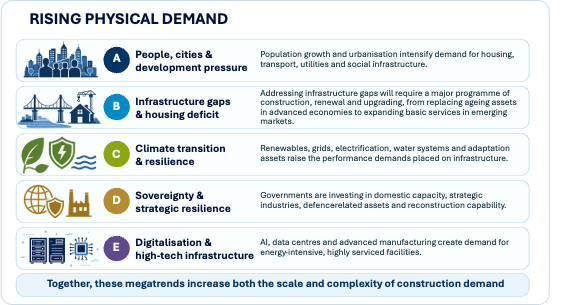
Population growth and urbanisation are intensifying pressure on transport, energy, water, sanitation and social infrastructure. Emerging and developing economies will account for a significant share of new construction as they respond to expanding urban populations and existing infrastructure deficits. Advanced economies will place relatively greater emphasis on maintaining, modernising and adapting ageing assets.
At the same time, the transition to a low-carbon economy requires extensive investment in renewable energy, electricity grids, transport systems and industrial infrastructure. Physical climate risks are creating an additional need to adapt buildings and infrastructure to higher temperatures, flooding, sea-level rise, drought, wildfire and more intense storms.
Geopolitical change is also bringing renewed attention to domestic industrial capacity, secure supply chains, defence infrastructure and reconstruction capability. Meanwhile, artificial intelligence, data centres and advanced manufacturing are generating demand for high-specification facilities supported by reliable energy, water and transport networks.
Why concrete matters
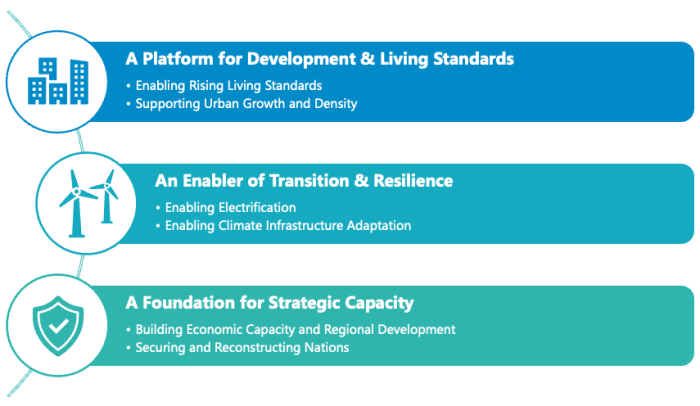
A platform for development
Concrete underpins many of the physical systems that support economic and social development, including homes, schools, hospitals, roads, railways, water systems and sanitation infrastructure.
Its strength, versatility and ability to perform in long-life applications make it suitable for infrastructure that must be delivered at scale. The report also highlights concrete’s role across different levels of dense urban environments, from tunnels, pipes and underground transport to roads, bridges and high-rise buildings.
An enabler of transition and resilience
The transition to net zero will require substantial physical infrastructure. Concrete is used in renewable-energy foundations, electricity networks, hydroelectric and nuclear facilities, charging infrastructure, and carbon capture, utilisation and storage systems.
It also plays a role in adaptation infrastructure, including flood defences, drainage channels, water-treatment facilities, desalination plants and coastal protection. The report estimates that approximately 85 billion tonnes of concrete will be required to support electricity-grid expansion between 2021 and 2050 under the stated scenario.
A foundation for strategic capacity
Concrete is generally produced close to where it is used. This production model supports local employment, regional supply chains and construction capacity while reducing dependence on the long-distance transportation of ready-mixed concrete.
The report also identifies concrete’s importance to strategic infrastructure, industrial facilities and reconstruction following conflict or natural disasters. It notes, however, that local production can still be affected by energy costs, permitting, aggregates availability, logistics, labour, land access and decarbonisation requirements.
Resilience and decarbonisation must be considered together
The world is facing a dual climate challenge. The built environment needs to reduce emissions while becoming more resilient to physical climate risks that are already increasing.
Low-carbon infrastructure that lacks durability may not deliver long-term sustainability. Equally, resilient infrastructure with a high carbon impact may become harder to finance, approve or insure. This creates a need to consider embodied carbon, operational efficiency, durability, maintenance and end-of-life circularity across the full lifecycle of an asset.
For cement and concrete, continued emissions reduction remains essential. The report points to the GCCA Concrete Future 2050 Roadmap for the industry’s full decarbonisation pathway, including action across clinker and cement, concrete production, design and construction, electricity decarbonisation, carbon capture, utilisation and storage, and the natural uptake of CO₂ by concrete.

Seven strategic considerations
The report identifies seven priorities for the industry, policymakers and the wider infrastructure sector:
- Measure social and economic value
Build credible evidence of the sector’s contribution to local communities, employment, economic capacity and living standards. - Understand changing demand
Track where infrastructure is needed, which assets must be delivered and how regional requirements are evolving. - Harness innovation and productivity
Improve concrete design, manufacturing and construction productivity so that more value can be delivered with fewer resources. - Embed resilience in decision-making
Consider long-term durability and climate performance in infrastructure business cases, procurement and insurance frameworks. - Preserve reliable supply
Manage rising costs while maintaining the capacity needed to meet demand for housing, infrastructure and adaptation assets. - Advance resilience and decarbonisation together
Reduce emissions while recognising the importance of durable, long-life infrastructure and different national development contexts. - Strengthen data, standards and evidence
Use transparent and comparable evidence covering embodied carbon, durability, recycled content and lifecycle cost.
Building the foundations of the future
The coming decades will require more housing, infrastructure, adaptation systems, energy networks, digital facilities and reconstruction capacity. Delivering these assets affordably and reliably, while meeting climate objectives, will be one of the defining global challenges.
Concrete must therefore be viewed as both indispensable to the built environment and part of the transition towards net zero. Its future role will depend on the industry combining scale, affordability and local availability with lower-emissions production, greater productivity and verified whole-life performance.
Learn more about Concrete’s Enabling Role in Building a Sustainable and Resilient Future