Co-processing: Material Recovery of the Mineral Fraction from Refuse-Derived Fuels in the Cement Industry.
This study was carried out by the Cement and Environment Labour Foundation (FUNDACIÓN CEMA), a tripartite foundation established by the Spanish Cement Manufacturers Association (OFICEMEN) and the two major trade unions in both the sector and Spain: CCOO del Hábitat and UGT FICA (Federation of Industry, Construction and Agriculture).
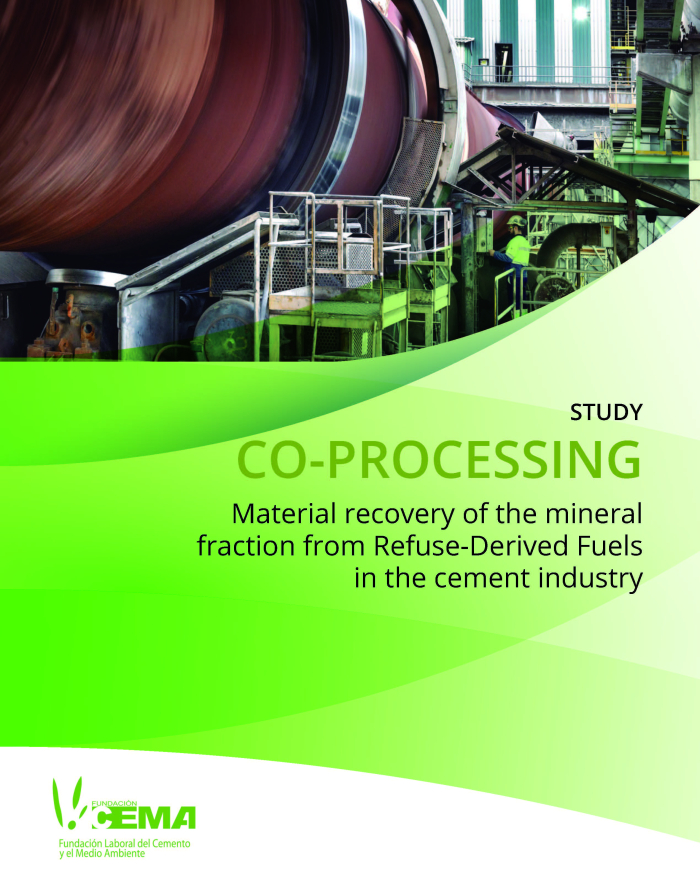
The document analyzes the material recovery potential of the mineral fraction contained in alternative fuels used in the cement industry—a process known as co-processing, which enables the simultaneous recovery of material and energy from waste.
Conducted by the Spanish Institute of Cement and its Applications (IECA) and the Technical School of Mining and Energy (Polytechnic University of Madrid), and promoted by Fundación CEMA, the research quantifies the recyclable mineral content in six major waste-derived fuel types, including industrial and municipal solid waste fuels, sewage sludge, end-of-life vehicles, waste wood, and meat and bone meal.
The analysis involved 63 samples from eight cement groups, using X-ray fluorescence and ICP techniques to determine ash content and calculate recycling performance through the international ISO 4349:2024 Recycling Index, which evaluates oxide compatibility with Portland clinker.
The results confirm that these fuels not only replace fossil energy but also substitute natural raw materials, providing significant material recovery rates. Recycling Index values based on nine oxides show material substitution ranging from 5.8% (municipal solid waste–derived fuel) to 25.8% (sewage sludge), demonstrating that co-processing contributes meaningfully to circularity objectives and supports its recognition beyond mere energy recovery within EU waste hierarchy considerations.