TSR Increase in RDF Co-Processing at Votorantim Cimentos’ Vidal Ramos Plant in South Brazil

At Votorantim Cimentos Brazil’s plant in Vidal Ramos (SC), a Chlorine Bypass system was implemented in 2022, enabling an increase in the thermal substitution rate (TSR) in the calciner through the use of RDF, going from 39% to 50%. Due to some characteristics of Brazilian RDF (a developing market), this advancement required a learning curve until early 2025, involving adjustments to the dosing system, coke control, and improvements in RDF quality, such as reducing ash content and eliminating contaminants to ensure calorific stability.
This was the first Bypass system installed by Votorantim in Brazil, becoming a benchmark for replication in other plants. The project resulted in greater co-processing capacity, reduced production costs, and a significant contribution to decarbonization goals, such as Net Zero 2030 and Circular Economy.
In 2025, the experience gained in Vidal Ramos accelerated the implementation of the second Bypass system at the Salto de Pirapora (SP) plant. Although still in the learning phase, initial results exceeded expectations, demonstrating synergy between units and leveraging lessons learned, which reinforces the strategy of expanding and consolidating RDF co-processing in Brazil.
At Votorantim Brazil, thanks to the increase in TSR and other improvements, net emissions dropped from 548 kg in 2023 to 536 kg CO₂/ton in 2024, with a target of reaching 475 kg by 2030. This success strengthens the company’s leadership in sustainable operations.
Co-processing in Alconera cement plant (Spain)
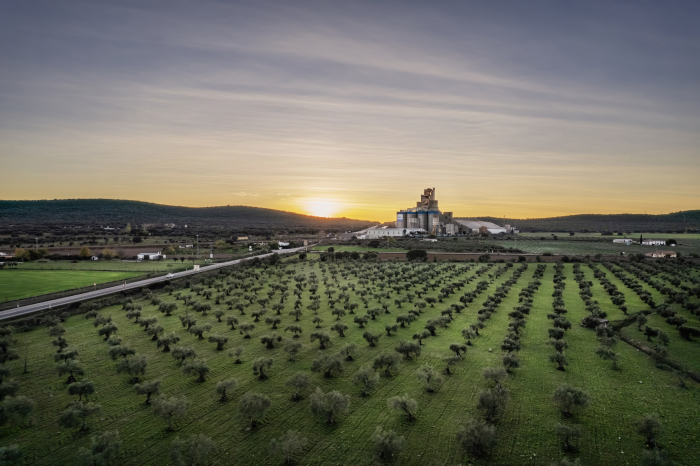
In Alconera, between 2022 and 2024, we prevented the emission of 173,461 tons of CO2, thanks to the use of 130,986 tons of waste that was reused as alternative fuel and raw material. This is equivalent to the volume of CO2 that would be offset by planting 7,9 million trees.
In 2024, our global emissions totalled 491 kg of CO2 per ton of cementitious product, a 23% reduction compared to 2022 (638 kg of CO2/ton of cementitious product).
Our Alconera cement site reached a thermal substitution rate of 41% in just six months in 2023 and of 54% in December 2024 using olive pomace and refuse-derived fuel (RDF). Each type of fuel is carefully selected according to its calorific value, chemical composition, physical properties, and environmental impact, ensuring a balanced and sustainable fuel mix, while respecting all permits and environmental emission limits.
The journey towards increased thermal substitution at Alconera has been supported by cutting-edge technologies for handling and processing alternative fuels and ensuring optimal combustion efficiency. Up until now, efforts have concentrated on injecting alternative fuels into the precalciner, aiming to achieve full substitution at this point of the process. We have incorporated a fully automated overhead crane to feed the material into the precalciner. We also installed a new burner and are putting into operation a new transport and dosing system. In addition, to ensure continuous supply of alternative fuels, we invested in a new storage hall with a capacity of 2,500 tons.
All these improvements have significantly increased the capacity of the Alconera plant to use alternative fuels safely and efficiently, thus reducing the plant’s emission factor and contributing to the fulfillment of our Net Zero 20230 and Circular Economy commitments.